STRICTER LIMITS FOR MERCURY EMISSIONS?
The thresholds for mercury emissions are already as low as the μg spectrum. To be able to monitor even tighter restrictions, measuring devices need to be extremely sensitive, accurate, and reliable.
These days, it is hard to believe that mercury (Hg) was still being used to cure illnesses at the beginning of the 20th century. Due to its deeply harmful properties, strict regulations regarding the use of this heavy metal now apply in a number of areas. In its liquid form, mercury evaporates at temperatures as low as room temperature. Impossible to see or smell, it is also a neurotoxin when inhaled into the lungs. As an exceptionally volatile substance, mercury can spread across large areas. Scientific institutes are currently taking measurements in polar regions to find maximum mercury values. As a result, UN climate policies are now demanding even stricter requirements to keep emissions of this toxic substance to a minimum. In January 2013, a total of 140 countries signed up to the Minamata Convention in Geneva, Switzerland, pledging to limit the mining of mercury, cut the amount of mercury emissions, and monitor waste.
Emission monitoring requirements focus primarily on power plants, incineration plants, and cement kilns that burn fossil fuels or waste. Waste incineration plants, for instance, have to pay special attention to items like batteries that have not been disposed of correctly and other electronic devices that contain mercury. Plant operators are adapting to these changes by employing better filter systems, improved gas cleaning systems, and even more accurate emission measurement devices to remain below the thresholds. The US government already drastically cut the limit for mercury emissions back in 2012 in light of the health risks posed by the substance. In Europe, the limit is specified by IED 2010/75/EU however is currently being revised with the BREF (Best Reference Methods) and will be drastically reduced in the near future. Plant operators all over the world should already start preparing themselves for meeting these lower emission limits. For example the limit values for Mercury will be in a range of 2/5… 20 µg/m3.
There are a number of products on the market that promise users accurate emission measurements. However, not all of these products are suited to meet the complex requirements. All statutory requirements are based on absolute emissions values, in other words, the total sum of elemental mercury Hg0 and oxidized mercury Hg+. The amounts and ratios of these two mercury forms in the flue gas depend largely on the raw materials being incinerated, the additional fuels, the gas flow in the process, and the purification process used for the flue gas. A quick and reliable mercury analyzer that can monitor the total amount of both mercury species is therefore crucial to the measurement process. This is where the MERCEM300Z by SICK comes in. The gas analyzer provides extremely reliable monitoring of mercury emissions down to a lowest certified measuring range of 0 bis 10 μg/m3.
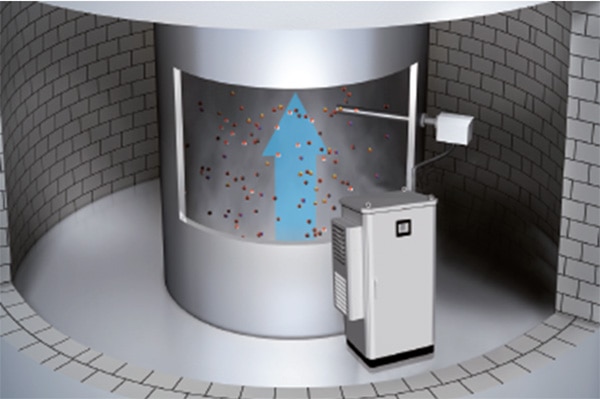
The MERCEM300Z combines thermal conversion at temperatures of around 1,000 °C with the fast measurement of trace or low Hg concentrations directly inside the heated converter. This enables it to supply reliable and continuous readings for actual flue gas concentrations. Continuous measurement directly in the hot converter combined with Zeeman atomic absorption spectroscopy (AAS) is patented and has been licensed exclusively for the MERCEM300Z from SICK. No chemical conversion, no particulate converter, and no gas cooling that may quickly distort the measurement result. Thanks to AAS technology, the measurement will not be affected by any other interfering components either. MERCEM300Z has a certified maintenance interval of three months for the smallest measuring range.
In the US, cement and power plant operators are also very happy with the mercury analyzer by SICK. In the US, emission limits are not based on a daily average but instead look at a 30-day average.
The sooner, the better: measuring mercury in raw gas
Reducing the level of mercury concentration during the treatment process is a sure way of adhering to emission limits at the end of the process. Improved measures for cleaning the raw gas enables plant operators to save additional costs and increase the safety of their systems. And this applies no matter what type of system is used.
In comparison to emission measurement, measuring mercury levels prior to the electric filter or prior to the scrubber requires a lot more effort due to the higher levels of dust and high concentrations of interfering components such as sulfur dioxide or hydrochloric acid. Nevertheless, the Hg value still has to be recorded at levels as low as the mg/Nm³ range. Measurement methods using an additional amalgamation step can be ruled out from the outset. This option would take too long to respond to Hg peaks.
Thanks to Zeeman AAS technology, the MERCEM300Z is also ideally equipped to take measurements in raw gas. The gas analyzer enables measurements to be taken without any further settings, without any additional equipment, and without any complicated operations. The set-up is exactly the same as for emission measurement. The MERCEM300Z is consistently accurate, detecting even the smallest milligram of mercury. It also boasts fast response times so that operators can react quickly to rising concentrations of mercury.
The majority of all flue gas cleaning units tend not to come with a cleaning stage designed especially for mercury. Injection of activated carbon prior to the electric filter or precipitants for the scrubber remove mercury from the process gas. However, these chemical additives are expensive and are often cut out of the process just for safety reasons. Operators are able to cut costs if they adjust the dosage according to current needs. The MERCEM300Z supplies reliable measured values for this purpose. If high levels of mercury collect over a longer period, this may lead to an excess of mercury in the flue gas scrubber and ultimately end up contaminating the entire plant. In a worst case scenario, the entire facility may have to be brought to a stop. However, this can be avoided. If an accurate measurement process enables high Hg concentrations to be detected in the raw gas, measures can be introduced to counteract them.